What your symptoms are revealing about stress, depletion and long-held patterns
There comes a point in midlife when the body stops absorbing quite so much.
The small compensations that once carried you through — a late night here, a skipped meal there, another week of pushing past tiredness — no longer disappear quietly into the background. They begin to register. They leave a mark. They ask to be noticed.
This is often how natural menopause announces itself.
Not as a single moment or clear beginning, but as a subtle change in how life lands inside you. Sleep becomes lighter. Emotions feel closer to the surface. Energy fluctuates in unfamiliar ways. Heat rises unexpectedly. The body seems less willing to be overridden.
It can feel like something is going wrong.
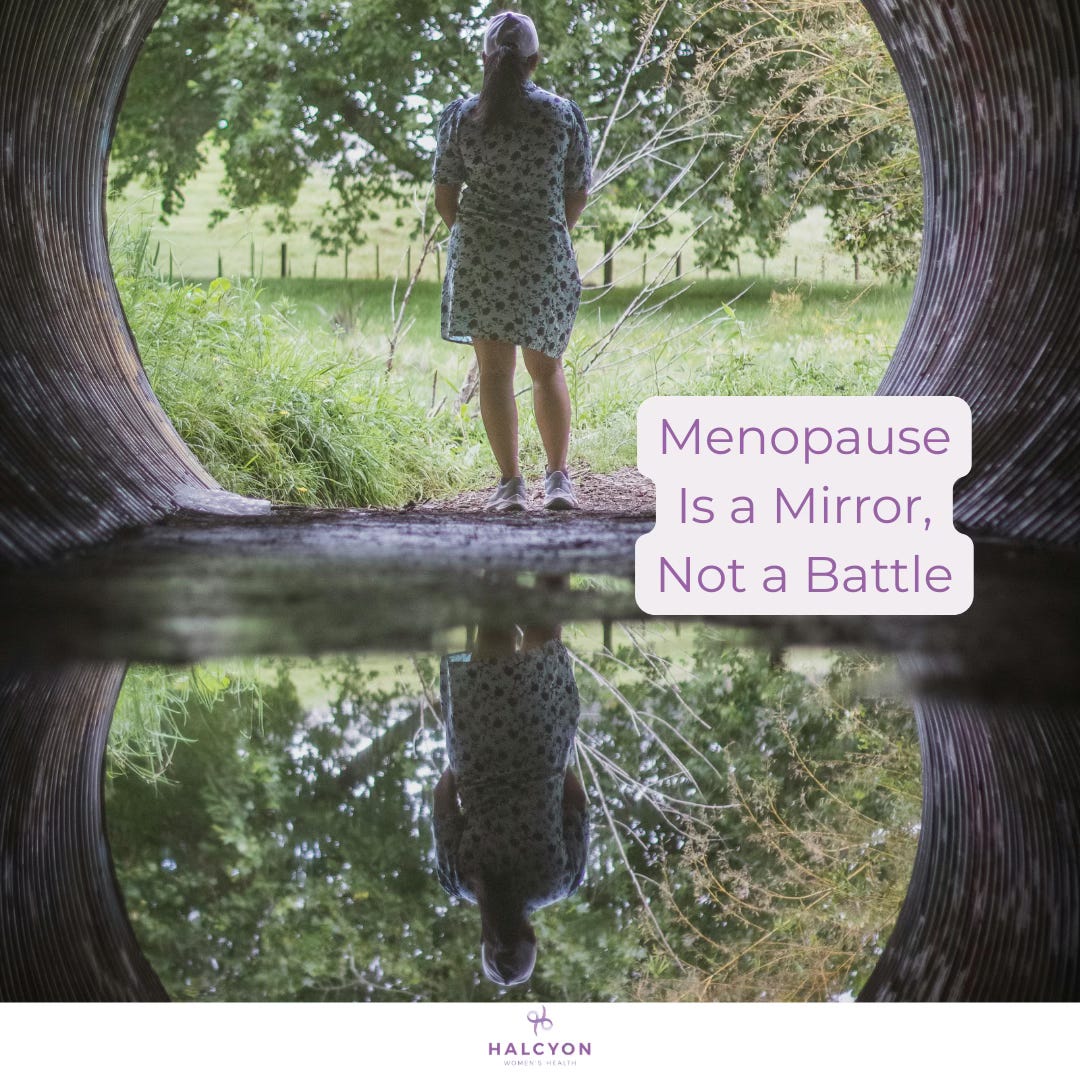
But another way to understand this phase is as a mirror — one that reflects back the life you have lived in your body so far. How much you’ve given. How often you’ve adapted. How long you’ve relied on resilience rather than replenishment.
A mirror doesn’t accuse.
It simply shows what’s there.
When the buffering softens
For much of adult life, oestrogen and progesterone quietly support a woman’s capacity to cope. They smooth stress responses, stabilise mood, protect sleep, support joints and connective tissue, and help the nervous system recover more easily from pressure.
As these hormones begin to fluctuate and decline, that support softens.
The result is not chaos — but honesty.
What was once tolerated now registers.
What was once absorbed now lingers.
What was once managed now asks for a different response.
This is why menopause can feel as though “everything has suddenly become harder”, even when nothing obvious has changed on the outside.
The same life is still there.
The same roles, responsibilities, relationships.
But the internal scaffolding has shifted.
Symptoms as information
Hot flushes, night sweats, fatigue, anxiety, joint pain, brain fog, emotional tenderness — these are often framed as problems to be solved or suppressed.
But symptoms are not arbitrary. They are responses.
They speak to how the system is functioning under current conditions.
Fatigue often reflects long-term overextension rather than laziness.
Anxiety may point to a nervous system that has been on alert for too long.
Sleep disruption can signal both hormonal change and accumulated stress.
Emotional reactivity often arises when the capacity to contain has thinned.
Seen this way, menopause doesn’t create difficulty.
It reveals where reserves have already been stretched.
Stress carried quietly
Many women arrive at menopause having lived for years — decades — in a state of low-grade, ongoing stress.
Not necessarily dramatic stress, but the kind that accumulates quietly:
responsibility without pause
emotional labour without recognition
prioritising others’ needs as a default
adapting rather than resting
coping rather than processing
The body is remarkably capable of holding this — until it isn’t.
Menopause often marks the point where the cost of that holding becomes visible.
The body begins to speak more clearly.
Less politely.
With fewer buffers.
This is not a failure of resilience.
It is the end of silent compensation.
A Traditional Chinese Medicine lens
Traditional Chinese Medicine understands menopause as a natural turning of seasons within the body.
Midlife is a time when Kidney energy — associated with deep reserves, vitality, hormones and longevity — becomes more precious. It asks to be protected rather than spent freely.
At the same time, the Liver system, responsible for flow, adaptability and emotional movement, may carry the imprint of years of restraint and responsibility. When life has demanded flexibility without space for expression, Liver qi can become constrained.
This often shows up as:
irritability or frustration
tension in the body
headaches or tight shoulders
disrupted sleep
emotional volatility
Blood, which nourishes the nervous system and anchors emotion, may also be depleted through stress, under-resting, heavy bleeding earlier in life, or long-term giving.
When blood and yin are low, heat rises more easily. The system becomes drier, hotter, less contained.
From this perspective, menopausal symptoms are not malfunctions.
They are signals from systems asking for nourishment, rest and flow.
The emotional mirror
Beyond the physical, menopause often reflects emotional patterns that have been held for a long time.
Many women notice that they are less willing — or less able — to:
smooth things over
stay silent
tolerate misalignment
carry responsibility alone
Emotions that were once managed internally may surface more readily. Feelings become harder to ignore. Boundaries feel more urgent.
This can feel unsettling, particularly for women who have built their sense of self around coping, competence or emotional steadiness.
But this shift is not a loss of control.
It is a re-orientation.
The body is no longer resourced to carry what was never meant to be carried indefinitely.
Depletion versus deficiency
It’s important to distinguish depletion from deficiency.
Deficiency suggests something missing that needs to be replaced.
Depletion points to something that has been used over time without sufficient restoration.
Menopause often brings depletion into focus.
Energy that was borrowed from tomorrow for years finally asks to be repaid. Sleep debt accumulates. Emotional reserves run low. The nervous system shows signs of fatigue.
Responding to depletion requires a different approach than responding to deficiency.
It’s not about adding more.
It’s about doing less — and restoring more deeply.
The nervous system at midlife
The nervous system plays a central role in how menopause is experienced.
Years of being “on” — alert, responsive, responsible — shape the baseline state of the system. When hormonal support reduces, that baseline becomes harder to sustain.
Symptoms such as anxiety, overwhelm, sensitivity to noise or stimulation, and emotional lability often reflect a nervous system that has been working without sufficient recovery.
Regulation becomes essential.
Not as a technique to master, but as a condition to be cultivated.
Safety, rhythm and predictability matter more than optimisation.
When pushing stops working
One of the most disorienting aspects of menopause is that strategies which once worked no longer do.
Pushing through fatigue backfires.
Ignoring signals leads to stronger ones.
Relying on willpower increases exhaustion.
This isn’t because you’ve lost strength.
It’s because the body is asking for a different relationship.
Menopause invites a shift from endurance to responsiveness.
From override to attunement.
Practical ways to meet the mirror gently
This phase doesn’t ask for dramatic change. It responds best to consistent, compassionate adjustments.
1. Protect your reserves
Treat energy as something precious. Notice where it leaks unnecessarily — emotionally, socially, physically — and gently plug one hole at a time.
2. Warm and nourish
Midlife bodies often respond well to warmth, regular meals, protein, healthy fats and cooked foods. Nourishment steadies both hormones and the nervous system.
3. Soften your days
Build in more transition time. Fewer sharp edges. Less rushing. The body reads pace as information.
4. Tend to the Liver
Gentle movement, stretching, time outdoors, creative expression and emotional honesty all support flow. Nothing elaborate is required.
5. Rest without earning it
Rest isn’t a reward. It’s maintenance. The body does not need justification to recover.
Listening without urgency
A mirror doesn’t demand action.
It invites observation.
Menopause asks for listening without panic.
What patterns are becoming visible?
Where has life been costing more than it gives back?
What has been postponed that now wants attention?
These questions don’t need immediate answers.
Sometimes awareness itself shifts the terrain.
Reflection
You might take a moment to sit with this:
What is my body showing me at this stage of life?
Where am I being asked to slow, soften or recalibrate?
What would it mean to meet this phase with curiosity rather than resistance?
Write if it helps. Or simply notice what arises.
Nothing needs to be fixed.
Closing thoughts
Menopause is not a battle to be won.
It is a revealing — of patterns, pressures, loyalties and costs that have accumulated over time.
When symptoms arise, they are not asking for suppression. They are asking for conditions to change.
Less strain.
More support.
Greater honesty with the body’s limits and needs.
When the mirror is met with gentleness, it doesn’t criticise.
It guides.
Next steps
My work supports women to navigate menopause as a meaningful transition — grounded in body wisdom, nervous system care and deep listening rather than struggle.
Because this phase is not about fighting your body.
It’s about learning to live in a way it can finally sustain.
If you’d like to chat, email me at sarah@halcyonwomenshealth.com