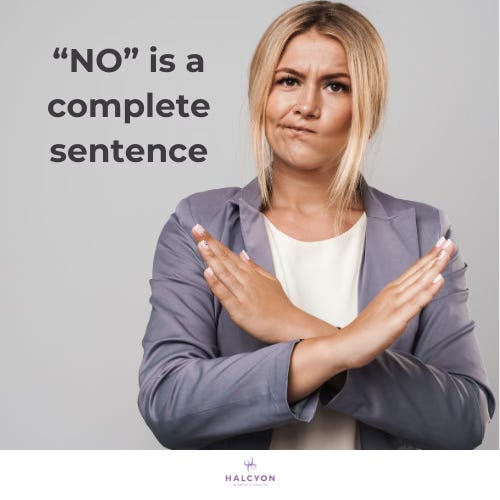
“No” is a complete sentence. And yet, for so many of us, it feels like a word made of glass - fragile, dangerous, liable to shatter in our mouths.
I learned to say no far later than I learned to over-deliver. For years, I said yes because it was easier in the moment.Easier than tolerating someone’s disappointment, easier than risking conflict, easier than sitting with the wobble of “Will they still like me?” And yet every yes that wasn’t truly mine left a little residue of resentment and exhaustion.
This came up in clinic again last week. My client (halfway through her programme for burnout and low self-esteem) looked at me and said, “I know I need to start saying no. I just freeze, say yes and then feel even worse.” So her homework this week? Say no on purpose. Not to be difficult; to be honest. Not to punish others; to protect herself. Not to close doors; to open the right ones.
I had to do the same homework myself and it’s no exaggeration to say that changed my life.
Why “no” matters (and why it can make you happier)
Saying no is not negative. It’s directional. It points your life towards what actually matters. Psychologically, it restores agency (think self-determination theory where autonomy is crucial for wellbeing). Physiologically, it lowers the constant cortisol trickle that comes from overcommitting and people-pleasing. Emotionally, it stops tiny resentments from transforming into burnout.
When you say no to the thing that drains you, you’re saying yes to rest, to creativity, to the walk that clears your head, to the early night that resets your hormones, to the hour you spend on what you actually care about. Or even just to your emotional safety.
That’s why boundaries don’t make you smaller. They make your life bigger.
So why does it feel so uncomfortable? Well, we were socialised, especially as women, to be agreeable, helpful, “nice”. That saying no was letting people down and to be “selfish” is a bad thing.
Many of us learned the fawn response (appease to feel safe) long before we had words for it. We recognised that saying no as a child was met with resistance (or worse), so our nervous system begins to interpret other people’s disappointment as danger. So, we say yes to avoid that potential harm.
Is it not right, or is it just new?
Sometimes the discomfort isn’t a red flag that something isn’t serving us, it’s simply the ache of stretching into something new. Misalignment discomfort (ie when it’s not right for us) often feels like a sinking gut, a tight throat, instant fatigue, tightening/rising shoulders, or a low-level dread. You may hear yourself rehearsing explanations or feeling secretly trapped.
Newness discomfort (when it’s anxiety of something different) often feels more like a fluttery of excitement, nervous energy, a rising breath, or tingly anticipation. You’re a bit scared but curious. You want to make it work.
They are both serving a purpose - one is your body saying “no, this isn’t right for you”, the other is your body saying “ah be careful this feels unfamiliar to us.”
The difference? If you ignore the first signals, you’re telling your body that you don’t hear it. You're gaslighting yourself, ignoring the warning, and carrying on regardless.
If you ignore the second one, you’re saying that unfamiliarity isn’t necessarily wrong - you can embrace new things and still be safe and happy.
The skill is being able to tell the difference…
Before you answer the request, give yourself permission to pause. You don’t owe anyone an instant reply. Then try this five-minute check-in:
Body barometer. Close your eyes. Name three sensations.
Expansion or contraction?
Breath deepening or getting shallow?
Jaw soft or clenched; shoulders loose or braced; belly warm or knotted?
Future-you check. Imagine you said yes. How do you feel the morning after? Light and curious or heavy and irritable?
Values test. Which values would this honour (e.g. health, family time, integrity, creativity)? Which would it violate?
Energy budget. If your week were a wallet, can you afford this? What would you have to spend less on (sleep, movement, food prep, quiet) in order for you to do this thing?
The “if I say yes, I’m saying no to…” sentence. Complete it honestly. If what you’re saying no to matters more, that’s your answer.
The most times you tune into these responses, the easier it becomes to read your body and hear the messages it’s sending you. Pretty soon, you can tell by your instant reactions if something is misaligned (ie when it’s the best thing to say ‘no’):
Jaw/teeth tension the moment a request lands, even if your face smiles. That mismatch is your boundary trying to speak.
Sudden energy drain around a person or task you’ve previously over-given to. Your system starts conserving before you’ve even decided.
Throat or solar plexus tightness as you type “Sure, no problem!”. Your body closes even as your words open. Pause there. That’s the decision point.
How to say “no” gracefully, clearly, kindly
You don’t need a speech, you need a sentence. Keep it short.
No apologies (unless one is truly due).
No over-explaining (over-explaining invites negotiation).
And speak gently, and with conviction.
It can help to practice saying no different ways, and see which ways and tools suit you best:
1) The clear, kind no
“Thanks so much for asking. I’m not able to take that on.”
(Full stop. If pressed: “I don’t have the capacity for it.”)
2) The values-based no
“I protect evenings for family/rest, so I’ll have to say no.”
(States principle; reduces debate.)
3) The capacity no
“My plate is full this month, so it’s a no from me.”
(Neutral, factual, non-personal.)
4) The no for now (if you’re open later)
“I can’t this week. If it’s helpful, I have more time in late October.”
(Only offer this if you mean it and are happy to agree the date there and then and add it, happily, to your calendar.)
5) The conditional yes (when you want to help, on your terms)
“I can’t do that, but I can do x/y/z if that is helpful?”
(Protects scope; prevents creeping commitment.)
6) The redirect
“I’m not the right person to ask, but X might be.”
(You’re helpful without abandoning yourself.)
7) The personal boundary
“I don’t discuss that.” / “I’m not comfortable with this.”
(Especially useful for intrusive questions or boundary pushers.)
Some of us find it easier to say no in some situations that others. Sometimes it’s easier to say no to family - sometimes they’re the hardest. Sometimes work is where we feel most put-upon and unable to “let people down” (you’re not btw).
Helpful prompts for common moments:
Work (extra tasks): “I’m at capacity with A, B and C. I’ll have to drop X/W/Z to take this on - which of these are you happy for me to let go?”
Friend (last-minute plans): “I’d love to see you. I need rest tonight. Can we book next week?”
Family (emotional labour): “I care about this, I just can’t give it attention right now.”
Shopping (pushing a decision): “Thank you. I’m not ready to decide today. I’ll come back to you after I’ve read the info.”
Tone matters. Keep it warm, steady, low. Exhale as you speak. Let silence do some of the work. You don’t have to fill it.
What to do with the wobble after you’ve said no
The hardest part often isn’t the no, it’s the after. The worry, the “Should I have…?”, the fear that you were rude.
Here’s how to stop the spiral:
Name it: This is the After-No Wobble. My nervous system is recalibrating. And that’s perfectly OK. Normalise it.
Do a 60–90 second reset:
Shake your hands/arms; roll your shoulders.
Breathe: in for 4, out for 6, five times.
Place a palm on your chest and one on your belly; feel the warmth.
Fact-check the fear: Write two columns - fear vs Facts.
Fear: “They think I’m selfish.”
Facts: “I said no once, calmly. They replied ‘No worries’.”
Use a short self-trust mantra: “I’m allowed to protect my energy.”
Close the loop: If you offered an alternative (“I do that on Wednesday though”), add it to your calendar so your mind can settle.
Make an evidence bank: Each time a no goes fine, note it. Your brain needs proof that boundaries don’t equal rejection.
Repair only if needed: If you were sharp, a short repair helps you as much as them: “Sorry I was abrupt earlier - I wasn’t in a good headspace. My answer is still no, but I wish you well with it/hope you have a good time.” etc (No over-apology. No reopening the negotiation.)
Where to practise (so the big stuff gets easier)
Start tiny. Say no to a newsletter you don’t read, to the group chat that drains you after 10pm, to the extra errand on an already full day. Small wins build the muscle.
Use a boundary buddy. Tell a trusted friend your intention. Text them your first “no”; let them send a cheer.
Pre-determine your boundaries. E.g. “I don’t schedule evening calls,” “I don’t accept meetings on Fridays.” Decisions made once reduce decision fatigue later.
Try the “48-hour hold”. When in doubt, buy time: “Let me check my diary and come back to you by Wednesday.” You’ll give a truer answer when your nervous system is calm.
A loving reminder (from someone who learned the hard way)
I used to think good people always say yes. Then I watched myself become less good! Less patient, less present, less me because I was stretched too thin to show up with warmth. The happiest, kindest version of me is the one who guards her energy fiercely and gives from overflow, not obligation.
If that resonates, here’s a simple homework you can borrow from my client’s programme:
This week: choose three deliberate “no”s. One at work, one at home, one with yourself (e.g. no to doom-scrolling after 10pm).
Write how it felt—before, during, after. Notice the wobble shorten with each attempt.
Celebrate the space you created. Even five minutes counts. Use it for something that makes you feel alive: fresh air, a stretch, a cup of tea in silence, a page in your journal.
You’re not here to be endlessly available.
You’re here to be true.
Every clear no is a yes to the woman you’re becoming.