

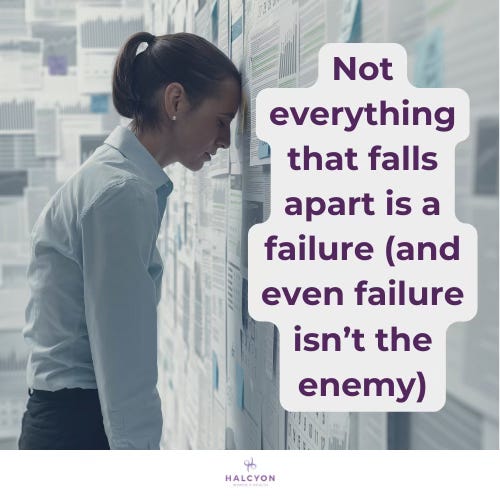
As women, we’re often conditioned to believe we can’t afford to fail.
Fail at holding it together? Lazy.
Fail at the diet? Weak.
Fail at balancing work, family, health, life? Not good enough.
So when things start to unravel, our default story is shame: “I’ve failed. I can’t do this. I’m not enough.”
And believe me, I’ve been there. I know that pit-of-the-stomach dread when it feels like all the plates you’ve been spinning crash at once. Even when that first one starts to wobble - that anxiety that “it’s all going wrong again.”
But falling apart isn’t always failure — and even if it is, failure is not the end of your story.
What is “falling apart”?
When I say “falling apart,” I don’t mean weakness or collapse in the way we’ve been taught to fear it.
Falling apart is that moment when the mask slips - when you can’t keep holding everything together with sheer willpower anymore.
It can feel like exhaustion so deep you can’t get out of bed, like bursting into tears in the supermarket (been there!!), like staring at your to-do list and feeling paralysed.
It’s the nervous system waving a white flag.
But beneath the fear and shame we often attach to it, falling apart is actually your body’s wisdom: a signal that something isn’t sustainable, a breaking down of what isn’t working so that space can be made for what will.
It’s not the beginning of an ending — it’s the pause before renewal. An invitation to reflect on what isn’t (and is) serving you.
Often, when we suffer many of these ‘fallings apart’, we can start to feel like failures. When we can’t see a way past, or around, the hurdles we’re up against, these feelings can feel insurmountable.
But even then, we haven’t failed.
Falling apart isn’t the same as failing.
Failure suggests that you tried and you weren’t good enough, that you didn’t meet a standard or expectation — often one set by someone else. It carries judgement, shame, and finality.
Falling apart, on the other hand, is a natural response to overwhelm, imbalance, or simply being human. It’s your body and mind saying pause, something needs to shift.
It’s not proof that you’re inadequate; it’s proof that you’re alive and responsive.
Where failure feels like a dead end, falling apart is more like a crossroads — a chance to lay down what’s too heavy, reset, and choose a new direction. Sometimes, what we label as “failure” is actually something else entirely: an invitation to reset.
A health flare-up that forces rest.
A relationship ending that creates space for deeper connection elsewhere.
A wave of exhaustion that makes you finally stop pushing.
Your nervous system, your hormones, your very cells are designed with resets in mind. Your menstrual cycle resets every month. The moon waxes and wanes. Nature withers, composts, and regrows.
Falling apart doesn’t always mean you’ve failed — it means your body or your life is asking you to begin again differently.
I remember a time when I felt like I was “failing” at everything. My health was crumbling, my energy was non-existent, my weight yoy-ed, relationships didn’t serve me, or I struggled to keep up with everything on my ‘to do’ list. For months (years really, if i’m being honest!), I carried the shame of thinking, “Why can’t I just do what everyone else seems to manage easily?”
But the truth was that I was always enough, and my body wasn’t betraying me — it was begging me to reset. To strip back the noise, soften into rest, and rebuild from a place of alignment instead of punishment. That reset changed everything. And now, it’s what I help other women reclaim for themselves.
Of course, sometime we do fail. Sometimes, that reset and reframe isn’t enough and we don’t manage to do what we set out to do.
And you know what - that’s OK too.
Why failure isn’t bad
Failure hurts, of course it does. But it also teaches. It strips away illusions and forces us to see what isn’t working. Sometimes we only find our truth when something collapses. And if we start to reframe failure as feedback, not a verdict on our worth, then is starts to feel a little less horrible.
We see “failure” everywhere:
Babies fail thousands of times before they learn to walk.
Our bodies “fail” old cells every day so that new ones can grow.
Entire seasons “fail” - summer “fails” into autumn, which “fails” into winter before spring can bloom.
Failure is not the opposite of success. It’s part of the process.
How to work with resets (and failures)
Here are three gentle practices to carry into your week:
Reframe the language. Instead of “I failed,” try: “I’ve learned something important.” Instead of “I’ve fallen apart,” try: “I’m resetting.” Language shifts the weight you carry.
Let yourself pause. Resets only work if we don’t rush straight into rebuilding. (This is one I struggle with in particular!) Sit in the pause. Breathe. Journal. Ask: What is this fall-apart clearing space for?
Practise embodied nos. Often, what looks like “failure” is actually our body saying no to misalignment. Stand tall, ground your feet, breathe low, and practise saying: “I can’t take that on right now.” Failure isn’t refusing — it’s redirecting.
A journaling prompt for this week:
Journalling can be a massive help when it comes to shifting our beliefs, thoughts and reactions to failure. It enables us to sit with ourselves at a deeper level, and work out exactly where we want to be. This prompt will help you start to look at the redirections that become possible once we strip away the negative:
“Where have I felt like I’ve failed and what new possibility might that failure be making space for?”
And if failure still feels like a bad thing. If you are struggling to see past the frustration and sadness that it brings, know that this is OK. Be gentle with yourself. And come back to it. Add a positive affirmation into your journalling:
“Falling apart is not the end. Failing is not the end. It’s the reset my body and soul are asking for.”
Repeat this, as often as you need to. It will empower you to gentle move forward, past the shame, anger and frustration to allow your brain to feel safe in reframing falling apart. From failure to feedback.
🧡 Final thought:
Sometimes we need support to reframe these thoughts and beliefs, or to invite in new rituals and patterns that serve us. Don’t be afraid to reach out if you need that extra support. That, too, isn’t fault - it’s a reset.
Have a great week.
With love, always,
Sarah x
Halcyon Days Collective's (Group Programmes)
Looking for a beautifully supportive way to shed what no longer serves, reframe stifling beliefs, and achieve your health & wellbeing goals in a sustainable and gentle way?
That’s exactly my Halcyon Days group programmes are designed for: 7 weeks of women’s circles, guided by me, where we look at techniques, self-treatments, and other resources to help guide you gently to where you want to be. Followed by three months of ongoing support, as a Collective, to lay down what’s too heavy and begin again gently, with guidance and sisterhood. Because sometimes, falling apart is simply the first step towards rising again.