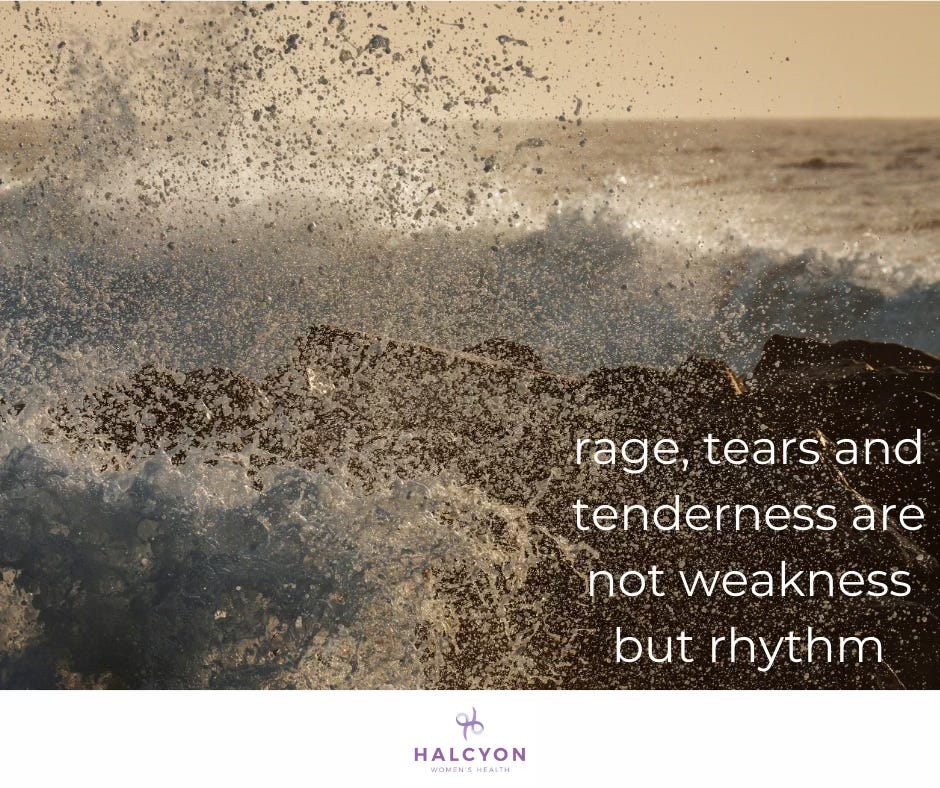
Why rage, tears and tenderness are not weakness but rhythm
There are days in the cycle when the emotional landscape shifts.
You might wake feeling a little more permeable than usual - as though the boundary between your inner world and everything around you has softened. Music touches you more deeply. A passing comment lingers longer than it normally would. Small irritations that you would usually brush aside gather weight.
And sometimes, without much warning, emotion rises.
Heat.
Tears.
Tenderness.
For many women, this is the part of the cycle that feels confusing or even unsettling. We live in a culture that quietly praises emotional steadiness - the ability to stay composed, consistent, measured. So when our inner weather begins to change, it can feel worrying and even awkward, embarrassing.
But within the natural rhythms of the female body, these emotional tides are neither random nor problematic.
They are part of the rhythm.
And when you begin to understand what your body is doing during this phase, something shifts. Instead of bracing against the waves, you begin to recognise the currents beneath them.
The cycle beneath the calendar
The menstrual cycle is often explained in neat biological stages: follicular phase, ovulation, luteal phase, menstruation. Hormones rise and fall in predictable patterns. Oestrogen climbs, progesterone follows, both eventually drop.
This explanation is correct but it is incomplete.
Hormones do not simply regulate reproduction. They influence the nervous system, the immune system, digestion, sleep patterns, metabolism and mood. They affect how we perceive the world and how the world feels inside our bodies.
As progesterone rises after ovulation, the nervous system begins to shift into a more inward orientation. Sensory awareness becomes sharper. The brain becomes more attuned to subtle signals - emotional cues, relational tension, changes in energy.
From a survival perspective, this makes perfect sense. Historically, if pregnancy had occurred, the body would need to be attentive to its environment. Sensitivity was protective.
Today, we often experience this same sensitivity as emotional intensity.
And of course, not every woman has her natural bleed - yet the rhythm does not vanish, it simply changes its anchor. Without the rise and fall of ovulation and menstruation, the body begins to lean more into other natural cycles that have always been present beneath the surface: the daily ebb and flow of cortisol and melatonin, the subtle lunar pull of the moon, and the slower seasonal rhythms of yin and yang. Oestrogen and progesterone no longer surge in the same monthly pattern, but they still flow, and the adrenal glands and nervous system still create waves of energy and rest.
But what if all of this - all of these emotional ups and downs and sensitivities - isn’t instability?
What if it’s information?
The Liver and the movement of emotion
Traditional Chinese Medicine has described the emotional tides of the cycle for thousands of years.
In this system, the Liver governs the smooth movement of qi - the vital energy that circulates through the body. When qi flows freely, emotions rise and fall naturally, like weather moving through the sky.
But when qi becomes constrained - through stress, unspoken emotion, overwork or tension - that movement becomes restricted. The energy gathers, looking for somewhere to go.
In the days leading up to menstruation, the body is already preparing for release. Blood and qi are beginning their downward movement. If emotions have been held or suppressed throughout the month, this phase can feel like pressure building behind a dam.
A sudden wave of irritation.
Unexpected tears.
A deep need for space.
These responses are not signs of emotional fragility. They are signs that energy is trying to move.
When it is allowed to move, the system resets.
When it is suppressed, the pressure continues to build.
What the nervous system is doing
From a somatic perspective, the nervous system is also playing its part.
Hormonal shifts during the luteal phase can make the brain slightly more sensitive to perceived threat. This doesn’t mean danger is present - only that the nervous system is scanning more carefully.
You may notice yourself becoming less tolerant of noise, clutter or emotional tension. Situations that felt manageable earlier in the month suddenly feel draining.
The body is simply more honest in this phase.
Where earlier in the cycle you might have smoothed something over or pushed through fatigue, now the nervous system quietly says: this doesn’t feel right.
Anger can surface here.
Not the explosive kind often portrayed in popular culture, but a more ancient, protective energy. Anger is the emotion that signals boundaries. It tells us when something has crossed a line or when we have been giving more than we have received.
In many women, this boundary-sensing energy has been suppressed for years.
So when it appears in the cycle, it can feel surprising.
But anger, when listened to rather than feared, can bring clarity.
The gift of tenderness
Alongside anger, there is often another emotional current: tenderness.
Moments when the heart softens unexpectedly. When a memory brings tears. When compassion for others - or for yourself - rises with unusual strength.
This tenderness is part of the same rhythm.
As progesterone begins to fall and the body prepares for menstruation, emotional barriers can become more permeable. Feelings that were held in the background drift closer to the surface.
In many shamanic traditions, this phase of the cycle was seen as a time of heightened intuition - when the boundary between conscious awareness and deeper knowing became thinner.
Women would withdraw slightly from daily demands, not because they were weak, but because they were listening.
Dreams became vivid.
Insights appeared suddenly.
Truths that had been avoided throughout the month came gently into focus.
Modern life rarely makes space for this inward turn.
But the body still moves through it.
When emotion feels overwhelming
Of course, sometimes these tides can feel more intense than we expect.
Years of unprocessed stress, trauma, hormonal imbalance or chronic inflammation can amplify emotional responses during the cycle. Conditions such as endometriosis, PCOS and PMDD often involve heightened sensitivity within both the hormonal and nervous systems.
In these situations, the emotional waves can feel sharper, heavier, harder to navigate.
But even here, the principle remains the same: the body is communicating.
Emotion is not the enemy.
It is the language the body uses when something needs attention.
When we begin to approach these moments with curiosity rather than criticism, the emotional tide often becomes easier to move with.
A gentle practice for emotional flow
One of the simplest ways to support emotional movement during this phase is through breath and gentle motion.
Qi Gong offers a practice that many women find surprisingly powerful in the days before their bleed.
Stand with your feet hip-width apart, knees soft.
Let your arms hang loosely by your sides.
Begin to gently sway your hips from side to side, allowing your torso and arms to follow naturally. The movement is small and unforced - more like a slow rhythm than an exercise.
As you sway, inhale slowly through your nose for a count of four.
Exhale through your mouth for a count of six.
With each exhale, imagine the tension in your abdomen and pelvis softening slightly.
Two or three minutes is enough.
This simple practice works on several levels.
The slow sway stimulates circulation through the pelvis and lower back, encouraging the movement of qi and blood. The extended exhale activates the parasympathetic nervous system, signalling safety to the body.
Over time, the body learns that emotion can move without needing to be suppressed or feared.
Listening to the tide
Perhaps the most powerful shift comes when you stop expecting emotional consistency from your body.
Your cycle is not a straight line.
It is a tide.
There will be days of outward energy, clarity and decisiveness. And there will be days of inward awareness, emotional sensitivity and reflection.
Neither is better than the other.
They are simply different expressions of the same rhythm.
When you learn to honour this ebb and flow, the emotional tides of your cycle stop feeling like disruptions.
They begin to feel like guidance.
A moment for reflection
If you pause for a moment now, you might ask yourself:
When in my cycle (or in the month, or day) do emotions feel closest to the surface?
What do those emotions usually seem to be pointing toward?
What might change if I allowed myself to listen rather than immediately fix or silence them?
There is no need to find perfect answers.
Simply noticing the pattern is often enough to begin.
Moving forward with your rhythm
Learning to move with your emotional tides is not something that happens overnight. It unfolds gradually, through observation, kindness toward yourself and a growing trust in the body’s wisdom.
This is exactly the kind of exploration we step into together inside The Lighter Way Collective.
It is a space for women who want to understand their bodies more deeply and move, lighter, through the peaks and throughs of energetic and emotional cycles - not through rigid protocols or pressure, but through rhythm, awareness and steady support.
If something in this piece has resonated with you, the doors are gently opening.
You can find out more here.