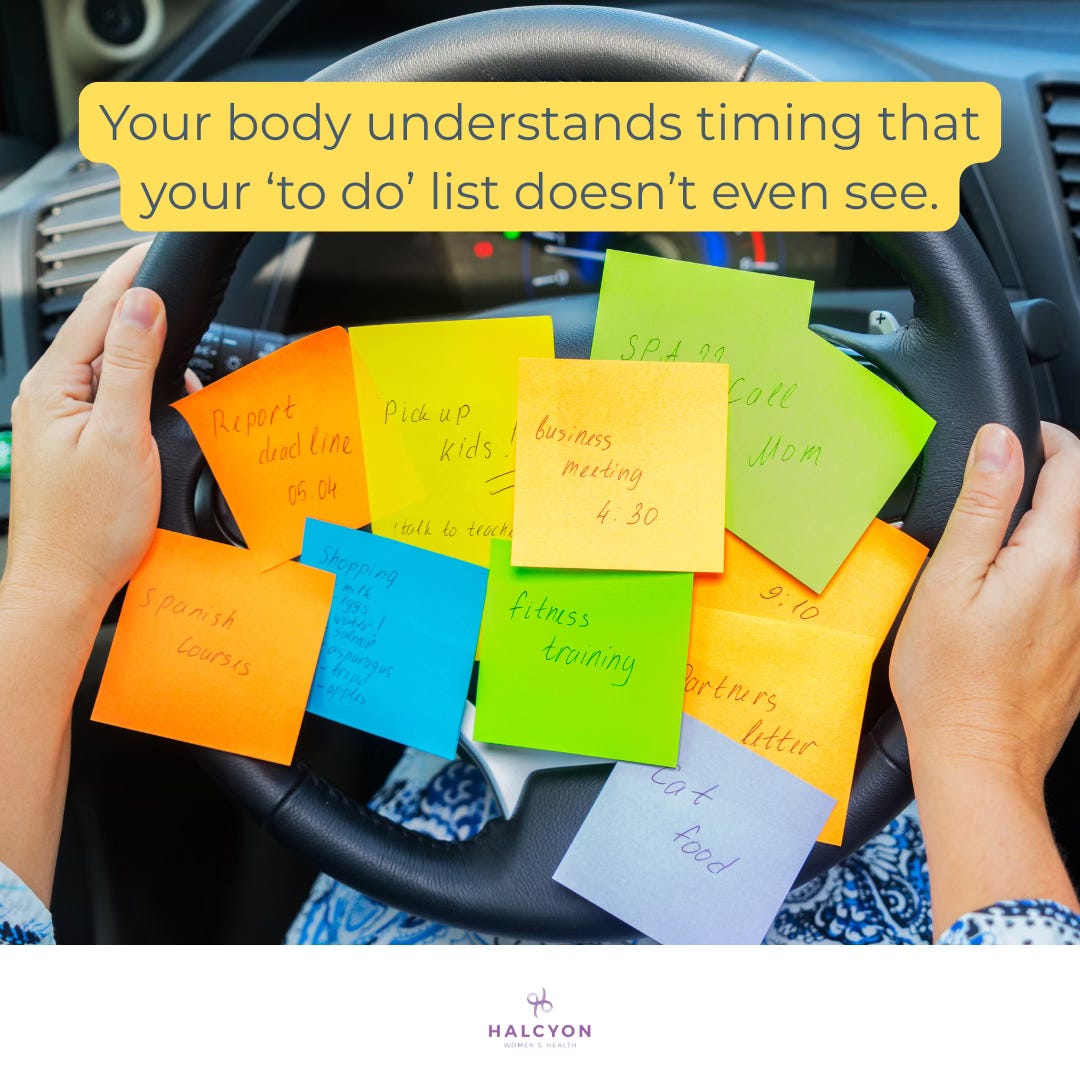
We’ve been taught to trust the list.
The planner.
The schedule.
The colour-coded intentions.
The January “get back on track” energy that insists now is the time to be disciplined, focused, productive, better.
And yet so many women are sitting quietly with a very different experience.
You might be doing all the right things — eating well, moving your body, trying to be consistent — and still feel flat, heavy, foggy, unmotivated, or strangely resistant. You might be staring at a to-do list that makes perfect sense on paper, but feels oddly impossible in your body.
And instead of questioning the list, you question yourself.
What if the problem isn’t that you’re failing to follow the plan…
What if the problem is that the plan isn’t following you?
What if your body is wiser than your to-do list this week?
The to-do list is logical. The body is strategic.
Your to-do list is built on logic. It loves consistency, repetition, forward motion. It assumes that every day is equal, that energy is stable, that effort always produces results.
Your body knows better.
Your body works in rhythms, not rules. In cycles, not straight lines. In seasons, not schedules. It understands timing, readiness, capacity. It knows when to push and when to protect. When to build and when to conserve.
When we override that intelligence — especially for long periods of time — the body doesn’t rebel. It resists quietly. Through fatigue. Through cravings. Through inflammation. Through a lack of motivation that isn’t laziness at all, but self-preservation.
So often, what we label as “lack of discipline” is actually mis-timed effort.
Why our goals so often fail the body
This is where I see women get stuck — particularly around health, hormones, and wellbeing.
You set a goal:
to lose weight
to earn more
to eat better
to get up earlier
to be more consistent
The goal itself isn’t wrong.
But the moment you try to implement it might be.
Trying to force dietary changes when cortisol is high, sleep is poor, or you’re recovering from illness.
Trying to train hard when your body is inflamed, depleted, or hormonally shifting.
Trying to be productive during weeks when your nervous system is still in recovery mode.
The body isn’t saying “no” to the goal.
It’s saying “not like this, not now.”
This is where so much unnecessary self-blame creeps in.
We’re taught that progress comes from doing more, tightening up, pushing through. But bodies don’t work like spreadsheets. They respond to appropriateness, not pressure.
The quiet cost of ignoring bodily timing
When we repeatedly ignore the body’s cues, something subtle happens.
Energy leaks.
You might notice:
Everything feels harder than it should
Small tasks feel disproportionately draining
Motivation comes and goes unpredictably
You oscillate between bursts of effort and total collapse
This isn’t a willpower issue. It’s a coordination issue.
Your mind is making plans your body hasn’t agreed to carry.
Over time, this disconnect erodes trust. You stop believing yourself when you say “I’ll start on Monday”. You stop trusting your own intentions. And the body learns that plans are something to brace against, rather than support.
What the body actually responds to
Here’s the part we’re rarely taught.
The body thrives on attunement, not enforcement.
It responds when:
effort matches capacity
change is introduced gradually
rest and action are allowed to coexist
goals flex around physiology, not the other way around
This doesn’t mean giving up on what you want. It means becoming far more intelligent about how you pursue it.
Think of it this way:
Your to-do list is asking, “What should I do?”
Your body is asking, “When am I ready?”
Both matter. But only one understands the cost.
Health isn’t built daily - it’s built rhythmically
One of the most liberating shifts I see women make is moving away from the idea that they must do everything every day.
Health doesn’t come from perfect daily behaviour. It comes from appropriate patterns over time.
Some weeks are for momentum.
Some weeks are for maintenance.
Some weeks are for repair.
If you’re only measuring success by output — steps taken, calories tracked, tasks completed — you’ll miss the quieter signs of progress:
improved sleep
steadier mood
fewer crashes
clearer thinking
less reactivity
These are not “nothing”. They are the groundwork.
Your body knows when it’s laying foundations.
The difference between resistance and wisdom
Does this feel hard because it’s new or because it’s misaligned?
New things often feel uncomfortable. Stretchy. Awkward. Slightly exposing. But underneath that discomfort, there’s usually curiosity, energy, or a sense of possibility.
Misaligned things feel different.
They feel heavy before you start. Draining while you’re doing them. And exhausting long after they’re done.
Your body is very good at telling the difference — if you slow down enough to listen.
Resistance doesn’t always mean fear.
Sometimes it means wrong timing.
Letting the body help you decide
What if, this month, instead of asking “what should I be doing?”
you asked “what has the most capacity to support me right now?”
That question alone can change everything.
It might lead you to:
scale goals down rather than abandon them
shift when you do something, not whether
prioritise regulation before optimisation
choose steadiness over intensity
This isn’t giving in. It’s collaborating.
Three gentle ways to work with your body this month
Rather than another list of rules, think of these as experiments — invitations to observe rather than perform.
1. Notice where energy flows easily.
What feels surprisingly doable right now? Not exciting. Not impressive. Just possible. Start there. The body builds confidence through ease.
2. Separate “consistency” from “rigidity”.
Consistency can mean returning again and again (gently, when you feel drawn to) — not doing the same thing every day. Let your body set the rhythm.
3. Ask for timing, not permission.
Instead of forcing yourself through resistance, ask: “When would this feel more supported?” You might be surprised how often the answer appears.
You don’t need to abandon the list - just dethrone it
Your to-do list isn’t the enemy. It’s a tool.
But it was never meant to outrank the body carrying it.
When you let bodily wisdom inform your plans, something softens. Goals stop feeling punitive. Health stops feeling like a performance. Change becomes something you enter, rather than something you force.
And perhaps most importantly — you stop mistaking intelligence for laziness, and wisdom for lack of drive.
A gentle closing thought
You don’t need to do less.
You don’t need to do more.
You may simply need to do things at the right time, in the right way, for the body you’re in right now.
And that body? She knows far more than she’s maybe been given credit for.
Next steps?
If this resonates, my work supports women and organisations to understand and work with hormonal reality — not against it.
Because sustainable change doesn’t come from pushing harder, but from listening better.
You can find out more here