I’m going to talk quite a bit about endometriosis this morning, because I have something happening this week that I really want to tell you about.
But if you don’t have endometriosis, please don’t disappear.
Because underneath all of that, this week’s Prompt is really about something much bigger and much more universal: what we do when something in our life feels so enormous, complicated or overwhelming that we don’t really know where to start.
That might be your health. It might be your hormones, your energy, your relationship, your work, your finances, something happening in your family or simply a period of life when there seem to be seventeen different things needing your attention at once.
And when that happens, I think our instinct is often to look for a big answer.
We want to sort it.
Understand it.
Make a plan.
Find the thing that will finally make everything feel manageable again.
But sometimes the sheer size of the problem becomes part of the problem. There are so many things we could do that we don’t know which one to do first. We read more, think more, make lists, ask questions, start three things at once, wonder whether we should be doing another five and somehow end up feeling even less certain than we did at the beginning.
Endometriosis is a particularly good example of this.
There’s the pain, obviously, but then there’s everything that can surround it. The tiredness, bloating, bowel symptoms, periods, hormones, disrupted sleep, changes in energy, the days when your body feels relatively predictable and the days when it seems to throw something completely new at you. There are appointments to make and appointments to wait for, treatments to consider, questions you meant to ask, symptoms you’re trying to remember, things you’ve Googled at eleven o’clock at night and things you wish you’d never Googled at all.
Then there’s all the advice.
Oh, the advice.
Eat this.
Don’t eat that.
Take this supplement.
Definitely don’t take that one.
Exercise more, but don’t overdo it.
Rest, but keep moving.
Look after your gut.
Sort out your hormones.
Reduce inflammation.
Regulate your nervous system.
Do pelvic floor exercises. No not those ones!
Get enough sleep.
Manage your stress.
And, of course, whatever you do, don’t get stressed about any of it.
It’s a lot, isn’t it?
But you don’t need endometriosis to recognise that feeling.
Most of us have had something in our lives that has become so tangled, so complicated or so full of possible things we should be doing that we’ve ended up almost frozen by it.
So perhaps this Monday we don’t need to solve the whole thing.
Perhaps we need to make it smaller.
Much smaller.
And simply ask:
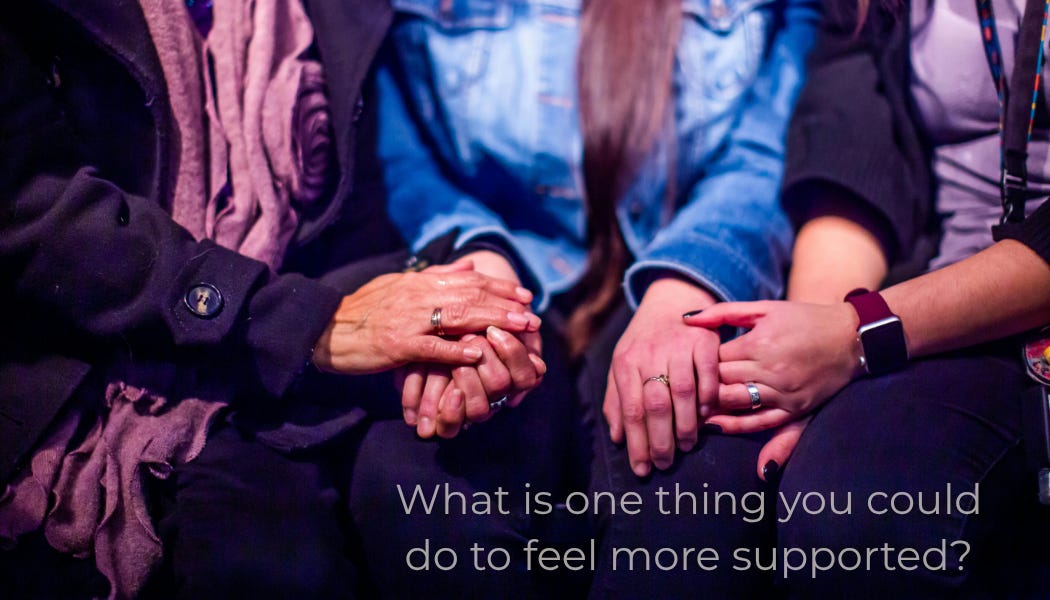
What is one thing I could do this week to feel a little more supported?
Not how do I fix everything?
Not what should I be doing better?
Not why haven’t I sorted this out yet?
Just...what would help me feel a little more supported right now?
And if you don’t have endometriosis, I’d love you to keep that question beside you as you read on.
Because although I’m going to use endometriosis as our example today, your one thing can be about absolutely anything.
Because support doesn’t always mean another treatment
I think when we’ve lived with a health condition for a while, it’s very easy to start thinking about our bodies as an endless project.
There is always something else we could try.
Something else we could change.
Something else we could investigate.
And sometimes, of course, treatment is exactly what we need. Sometimes the next thing really is speaking to your GP, chasing an appointment, discussing medication, asking for another opinion or getting a symptom investigated.
But support can be much broader than treatment.
It might be finally explaining to your partner what your bad days actually feel like instead of automatically saying, “I’m fine.”
It might be putting some practical support in place at work.
It might be keeping your evening free because you know your period is due and your body tends to need more from you then.
It might be getting the hot water bottle out before you reach the point where you can barely move.
It might be tracking your symptoms for a while so you can begin to notice what your body is doing rather than feeling completely blindsided every time something changes.
It might be moving gently because your whole pelvis and lower back feel tight and guarded, or deciding that today movement is absolutely not what you need and curling up somewhere warm instead.
It might be asking somebody for help.
It might be learning something.
It might even be deciding that you have spent quite enough time thinking about endometriosis this week and doing something that has absolutely nothing whatsoever to do with it.
Support doesn’t have to be impressive to count.
And it certainly doesn’t have to involve completely reorganising your life.
Sometimes the thing we need most is understanding
This is something I come back to again and again in my work with endometriosis.
Because there is a huge difference between knowing that you have endometriosis and actually beginning to understand what that might mean for your body.
You can have a diagnosis and still have a hundred unanswered questions.
Why can one month be manageable and the next completely floor you?
Why can your digestion suddenly go haywire around your period?
Why can your whole abdomen feel tight?
Why does your energy disappear?
Why do symptoms sometimes flare when you haven’t knowingly done anything differently?
What do hormones have to do with it? What about inflammation? Your nervous system? Stress? Sleep? Your bowel? Your pelvic floor? The way your body responds to pain?
And how on earth does all of that fit together?
I think this is where women can end up feeling particularly lost, because healthcare understandably has to focus on diagnosis and medical treatment, but you are the one who then has to go home and live in the body that has been diagnosed.
You have to work out what Tuesday looks like.
You have to work out whether you can make that meeting, whether you need to cancel dinner, whether that new pain is something you need to worry about, what helps when your stomach swells, what your body needs when you’re exhausted, and how to explain any of it to the people around you.
That’s why understanding matters.
Not because I think you need to become an expert in every biological process happening inside you, but because understanding can take away some of the fear and helplessness.
It gives us somewhere to start.
Instead of my body is doing something awful again, we can begin to get curious about what might be contributing.
Instead of there’s nothing I can do, we can begin to notice where we do have choices.
And instead of trying seventeen things at once and having no idea whether any of them helped, we can begin to make smaller, more thoughtful changes and see how our own body responds.
That, to me, is where some of our power comes back.
Not through controlling our bodies.
Through knowing them.
You don’t need to do everything
If you’ve followed my work for any length of time, you’ll probably know that I’m interested in the whole person.
I’m interested in what’s happening physically, of course, but I’m also interested in sleep and stress and hormones and digestion and movement and emotional wellbeing and the nervous system and what is actually happening in somebody’s life.
Because bodies don’t live separately from lives.
And that means there are often lots of different places we could begin.
But “lots of places we could begin” can very quickly turn into “lots of things I should be doing”.
I don’t want that for you.
I would much rather you understood five possible ways of supporting yourself and chose the one that actually made sense for your body and your life than went home with a list of twenty-seven things and felt guilty because you only managed two of them.
You don’t need to become brilliant at having endometriosis.
You don’t need to turn managing your health into a full-time hobby.
And you don’t need to get everything right.
Sometimes we just need to know enough to make the next decision.
So perhaps your one thing this week is simply giving yourself 90 minutes to understand a little more
I’m going to be completely transparent here, because this Monday Morning Happiness Prompt is also an invitation.
This Thursday, 1 October, I’m running the first of my new Making Sense of Endometriosis workshops, and the whole reason I created these sessions is because I know how overwhelming it can be to try to piece all of this together by yourself.
It’s a 90-minute online workshop where we can slow everything down a little and start making sense of what’s actually going on.
We’ll talk about endometriosis itself, but we’ll also begin looking at that wider picture - how symptoms can connect, why your experience can change, what may be influencing the way you feel and where there may be opportunities to support your body alongside whatever medical care you’re receiving.
There will be practical things you can take away, of course, but I don’t want you leaving with yet another giant self-care list.
I want you leaving with a better understanding of yourself.
I want some of those scattered pieces to start joining together.
I want you to be able to think, Ahhh. That makes a bit more sense now.
And perhaps most importantly, I want you to come away with some idea of what your next thing might be.
I’ve lived with endometriosis myself for years, and I’ve spent years working with women living with it too, and one of the things I know is how easy it is to start feeling as though your body is calling all the shots.
Pain decides what you do.
Your period decides what you do.
Your energy decides what you do.
Appointments and waiting lists and flare-ups and symptoms begin making decisions for you.
Understanding your body doesn’t magically remove all of that.
But it can give you more ways to respond.
And sometimes that little shift - from what on earth is happening to me? to I understand a little more about what might be happening here, and I know what I can try next - is enormous.
What would support look like for you?
Maybe the workshop isn’t your one thing this week.
I genuinely mean that.
Perhaps reading this has made you realise that what you actually need is to make the appointment you’ve been putting off.
Perhaps you need to ask for some help.
Perhaps you need to start writing your symptoms down.
Perhaps you need to have a conversation with somebody close to you.
Perhaps you need to rest.
Perhaps you need to stop reading about endometriosis for a few days and go and do something that reminds you that you are a whole person with interests and pleasures and plans that have nothing to do with your pelvis.
But perhaps your one thing is coming along on Thursday.
Perhaps you’ve been trying to understand all of this by yourself for long enough.
Perhaps 90 minutes in the middle of the day, with a cup of tea beside you, listening, learning, asking questions and beginning to put some of the pieces together would feel supportive.
Not a promise that everything will change overnight.
Not another enormous commitment.
Just a place to start.
And that’s really what I want you to take from this Monday’s Prompt.
When something feels huge, we often think we need a huge answer.
We don’t always.
Sometimes we just need the next useful thing.
The next conversation.
The next appointment.
The next question.
The next bit of information.
The next small act of care.
So have a little think today.
What is one thing I could do that would help me feel more supported with my endometriosis?
And whatever answer comes up, see whether you can take one small step towards it.
You don’t have to sort everything.
You don’t have to know everything.
You don’t have to do everything.
Just find your one thing.
And if that one thing is joining me on Thursday, I’d love to spend those 90 minutes with you. 🧡
Making Sense of Endometriosis
Thursday 1 October | 12.00–1.30pm | Online (recording provided)
£35
Come exactly as you are. Bring your questions, bring a notebook if you want one, bring your lunch if that’s when you need to eat it.
And let’s make some sense of this together.
Book your place here.