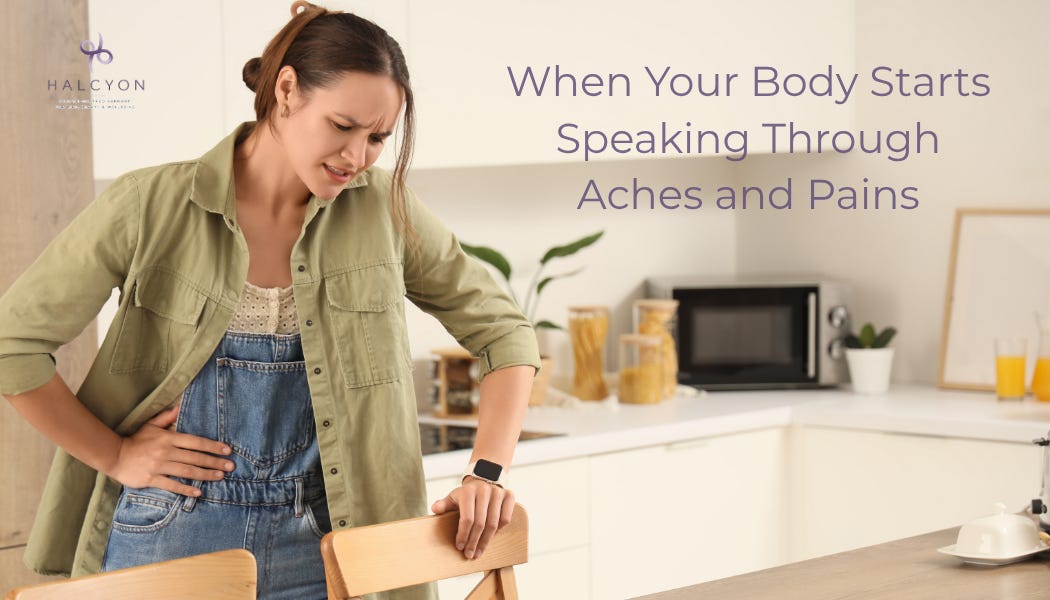
Perhaps you’ve noticed it yourself.
You wake up and your shoulders feel stiff, even though you haven’t done anything unusual.
Your hips seem tighter than they used to.
Your lower back grumbles as you stand up.
Your knees complain on the stairs.
Your neck feels as though it’s carrying the weight of the world.
Nothing dramatic has happened.
You haven’t fallen over.
You haven’t injured yourself.
Yet your body feels different.
Many women tell me they begin wondering whether they’re simply “getting older.”
Others worry they’re becoming less fit, less capable or somehow less resilient than they used to be.
But often, there’s another conversation happening beneath the surface.
One involving hormones, inflammation, the nervous system and the remarkable way the body adapts to the changing seasons of a woman’s life.
More than just wear and tear
It’s tempting to imagine the body like an old jumper.
The older it gets, the more worn out it becomes.
But that’s rarely how women’s bodies work.
Hormones influence almost every tissue in the body.
Oestrogen, for example, helps support collagen production, keeps connective tissues supple, influences joint lubrication and even plays a role in how we perceive pain.
As hormone levels fluctuate during the menstrual cycle, after pregnancy, during perimenopause and into menopause, muscles, ligaments and joints may simply feel different.
Many women notice that certain aches seem to come and go with their cycle.
Others find everything stiffens after a poor night’s sleep or a particularly stressful week.
That’s because hormones never work alone.
They are constantly dancing with your immune system, your nervous system, your sleep, your previous injuries, your inflammation, your digestion and your emotional wellbeing.
Your body is always responding to the whole picture.
The body protects before it complains
One of the most fascinating things we understand through somatic work is that muscles often tighten to protect us.
Not only after physical injury but after emotional load too.
Think about how you instinctively brace when someone shouts.
How your shoulders rise during a stressful meeting.
How your jaw tightens when you’re trying not to cry.
Your body is extraordinarily good at keeping you safe.
The difficulty comes when protection quietly becomes the default.
Weeks become months.
Months become years.
The muscles never quite receive the message that it’s safe to soften again.
Stress hormones remain a little higher.
Breathing becomes shallower.
Inflammation lingers.
The nervous system stays quietly alert.
Eventually the body begins communicating in the only language it has.
Sensations.
Physical feelings.
Why hormones can amplify aches
Around ovulation, many women feel more mobile and energetic.
As progesterone rises afterwards, tissues can feel different again.
During perimenopause, fluctuating oestrogen often contributes to joint stiffness, muscle aches and seemingly random pains that appear overnight.
Women living with endometriosis, adenomyosis, PCOS or chronic stress often notice similar patterns too.
Not because everything is hormonal but because hormones influence how the whole body experiences inflammation, recovery and pain.
When sleep is poor, cortisol rises.
When cortisol remains high for too long, muscles recover less efficiently.
Pain sensitivity increases.
Everything begins feeding everything else.
The encouraging part?
The opposite is true as well.
Small improvements in sleep, hydration, movement and nervous system regulation often ripple through the whole body.
Traditional Chinese Medicine sees a pattern
Traditional Chinese Medicine has never viewed aches and pains as isolated events.
It asks different questions.
Where does the pain move?
What makes it better?
What makes it worse?
What season are you in?
How are your energy levels?
How are your emotions?
Often, pain is understood as a place where qi and blood are no longer flowing freely.
Sometimes because of overwork.
Sometimes because of stress.
Sometimes because of hormonal change.
Sometimes because the body has been carrying more than it was ever meant to carry alone.
The aim is not to battle the pain.
It’s to restore movement.
Movement in the body.
Movement in the breath.
Movement in the emotions.
Movement in life.
What happiness has to do with aching muscles
Joy changes physiology.
When we laugh, breathe deeply, spend time with people who feel safe, walk in nature, dance in the kitchen or become absorbed in something we love, the nervous system shifts.
Muscles receive a message that they no longer need to brace quite so tightly.
Breathing deepens.
Circulation improves.
Inflammatory chemicals reduce.
Pain doesn’t necessarily disappear overnight but the body often begins to soften.
Sometimes happiness isn’t the reward for feeling better.
Sometimes it becomes part of what helps us feel better.
Five gentle ways to help your body soften
Move kindly, not heroically.
Your joints usually prefer frequent, gentle movement to long periods of sitting followed by intense exercise.
A ten-minute walk, some stretching or gentle Qi Gong can be enough to remind tissues that they’re safe to move.
Drink before you’re thirsty.
Hydration supports joints, muscles, fascia and every hormonal conversation taking place inside your body.
Your tissues can’t glide well when they’re running dry.
Use warmth wisely.
A warm bath, heat pad or gentle self-massage encourages circulation and helps muscles let go of unnecessary tension.
Notice how your body responds.
Breathe into where you ache.
Place your hands over the area that’s calling for your attention.
Rather than trying to make the sensation disappear, simply breathe slowly towards it for a few minutes.
You’d be amazed how often muscles respond to being acknowledged rather than ignored.
Create one joyful moment every day.
Not because joy cures pain.
Because your nervous system deserves reminders that life contains safety, pleasure and ease alongside responsibility.
A gentle practice
This week, choose one area of your body that’s been asking for your attention.
Place both hands there.
Close your eyes.
Take five slow breaths.
Instead of asking,
“Why are you hurting?”
Try asking,
“What are you trying to tell me?”
Then simply listen.
You don’t need an answer immediately.
Sometimes the body responds in words.
Sometimes in memories.
Sometimes in a sigh.
Sometimes simply in a feeling of softening.
All of those responses are welcome.
A reflection
Perhaps this week, ask yourself:
What if my body isn’t working against me?
What if these aches are invitations to slow down, nourish myself and move a little differently?
Not every ache has a profound meaning.
Sometimes a shoulder is simply a shoulder.
But sometimes the body is quietly asking for the kindness we’ve been offering everyone else.
A gentle next step
Inside The Lighter Way Collective, we spend time understanding the whole picture of wellbeing - hormones, movement, nervous system health, emotions, nutrition and the small daily practices that help women feel lighter in their bodies and happier in their lives.
Because there isn’t one magic answer - small, compassionate changes often create remarkable ripples.
If you’d like to explore that gentler way together, I’d love to welcome you.
You can find out more here.
Until next week, be gentle with yourself 🧡