

There’s a particular kind of tiredness that arrives in midlife or when your cycles are disrupted.
Not the kind that follows a late night or a busy week. Not the satisfying ache of effort well spent.
This one sits deeper.
It lingers in the bones. It dulls the edges of motivation. It makes even small decisions feel heavier than they used to. It hums beneath the surface of the day - present whether you slept well or not.
And almost without noticing, many women begin to interpret this tiredness as something about who they are.
“I’m just not as driven.”
“I’m getting lazy.”
“I’ve lost my edge.”
“I used to cope better than this.”
Exhaustion quietly becomes an identity.
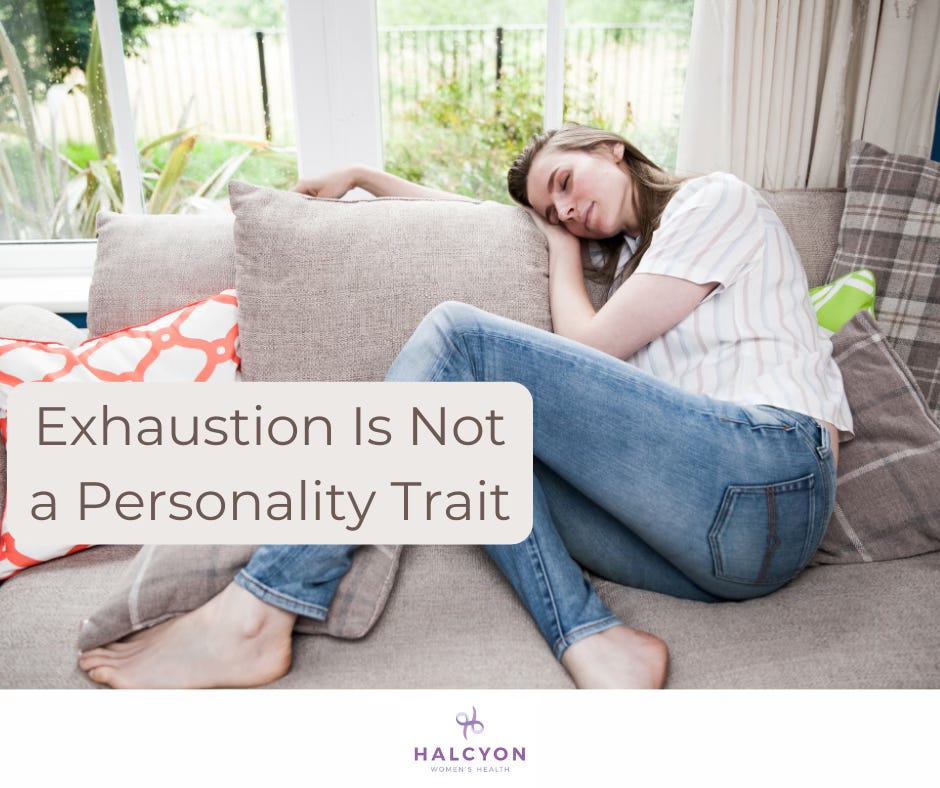
But exhaustion is not a personality trait.
It is a signal.
And in midlife - often long before - it is a profoundly intelligent one.
For many of us, the first time we truly meet this deeper fatigue is not in menopause, but in the years leading towards it. Cycles begin to shift. Sleep becomes lighter. Stress lands differently. Recovery takes longer.
I remember a period in my late thirties when I was functioning - outwardly - exactly as I always had. Work going well. Responsibilities handled. Social life maintained. From the outside, nothing had changed.
But inside, something had.
By mid-afternoon I felt as though I was walking through porridge. My thoughts were slower. My body felt heavier. And instead of responding with curiosity, I responded with criticism.
Why can’t you just get on with it?
That voice is familiar to many women.
We have been praised for endurance for so long that we mistake depletion for weakness.
From a physiological perspective, midlife fatigue makes sense.
Oestrogen and progesterone, which for decades have supported mood, sleep architecture, mitochondrial function and stress recovery, begin to fluctuate and decline. Cortisol rhythms can become dysregulated after years of pressure. Blood sugar stability shifts. Thyroid sensitivity changes.
Add to this the cumulative load of caregiving, career, emotional labour and unprocessed stress and the body begins to ask for a different pace.
Not because it is failing.
Because it is recalibrating.
A Different Lens
In Traditional Chinese Medicine, this phase is understood through the lens of Kidney energy - our deep reserves, our inherited vitality, the well from which we draw over a lifetime.
In youth and early adulthood, we spend freely. In midlife, the body becomes more discerning. Kidney energy asks to be protected, not constantly spent. When it is overdrawn, fatigue, lower back ache, brain fog, and a sense of dwindling motivation can arise.
At the same time, the Spleen - responsible for transforming nourishment into usable energy - may be weakened by years of irregular meals, cold foods, overthinking, and constant output. When the Spleen is tired, energy feels foggy rather than bright. Limbs feel heavy. Concentration drifts.
This isn’t poetic metaphor. It’s embodied reality.
The body has been generous for decades.
Now it wants reciprocity.
From a somatic perspective, exhaustion is rarely just about hours slept.
It is about how much tension is being held in the system.
Shoulders that never fully drop.
A jaw that tightens through conversations.
Breath that stays shallow and high in the chest.
A mind that continues processing long after the day is done.
This kind of holding consumes energy continuously.
When women say they are tired “for no reason”, there is almost always a reason - but it lives in the nervous system rather than the diary.
Chronic vigilance is exhausting.
Constant adaptation is exhausting.
Suppressing emotion is exhausting.
Midlife has a way of making this visible.
When the mask slips
What makes this type of exhaustion particularly confusing is that it often shows up differently depending on where you are.
At work, many women report being able to “switch on”. There is structure. There are roles. There is clarity of expectation. Adrenaline is available. Competence is familiar territory.
At home, the edges soften. The nervous system drops a layer. And suddenly the fatigue is undeniable.
This contrast can create doubt.
“If I were really that tired, I wouldn’t be able to function at work.”
But the nervous system is clever. It mobilises when required. It borrows from reserves. It prioritises performance in structured environments.
It is in the spaces where you feel safe - or less observed - that the body finally lets the mask slip.
Home often becomes the place where the cost of coping is felt.
This isn’t inconsistency. It’s biology.
There is also a cyclical dimension to this, whether you bleed regularly, irregularly, or not at all.
It’s cyclical even when your bleeds aren’t regular
Women who still menstruate often notice a wave-like pattern to their energy. There are days of outward focus, clarity and movement - and days that naturally incline towards reflection, softness and reduced output.
Even when bleeding has stopped, these rhythms do not disappear. They become subtler, often syncing more closely with the lunar cycle or seasonal shifts.
You may notice that certain weeks of the month feel more expansive, and others more inward. That your energy rises around a new project and wanes once it stabilises. That winter draws you into slower mornings, while spring stirs restlessness and possibility.
The body remains cyclical long after ovulation ceases.
Ignoring this rhythm creates friction. Honouring it creates flow.
Gentle ways to minimise the fatigue
Leaning into cyclical energy - even when cycles are irregular or absent - begins with observation rather than overhaul.
Notice when your energy rises naturally during the month. What kinds of tasks feel easier then? Creative work? Social engagement? Strategic thinking?
Notice when your energy dips. What does your body incline towards? Simplicity? Repetition? Solitude? Earlier nights?
Instead of forcing uniform productivity, experiment with alignment.
Schedule outward-facing tasks during higher-energy phases where possible. Protect lower-energy windows for administration, reflection or rest.
This isn’t indulgence. It’s intelligent energy management.
From a TCM perspective, supporting fatigue involves warmth, nourishment and rhythm.
Warm, cooked meals over cold grazing.
Regular eating rather than long stretches of under-fuelling.
Early nights where possible.
Gentle movement that moves qi without depleting reserves - walking, stretching, Qi Gong, slow strength work.
Kidney energy responds to consistency.
Spleen energy responds to steadiness.
From a somatic lens, small daily resets matter.
Three long exhales before opening your laptop.
Feet flat on the floor between meetings.
Shoulders consciously softening when you notice they’ve risen.
Stepping outside for light and air rather than pushing through.
These are not grand interventions. They are signals of safety to a nervous system that has been running fast for a long time.
The bigger questions
There is also an emotional layer to midlife exhaustion.
For many women, this stage of life coincides with reassessment.
Children growing or leaving. Parents ageing. Careers plateauing or intensifying. Relationships evolving.
The question beneath the fatigue is often not just “How do I get more energy?” but “Is this how I want to be spending it?”
That question can be confronting.
Fatigue sometimes appears when something in your life is misaligned - when effort is being invested in places that no longer nourish in return.
The body feels that before the mind articulates it.
If you recognise yourself here, the invitation is not to fix your tiredness.
It is to listen to it.
What is this exhaustion asking for?
Where have you been overriding your natural rhythm?
What would change if you treated energy as cyclical rather than constant?
You might choose one small experiment this week.
Go to bed thirty minutes earlier without negotiation.
Eat breakfast warm and unhurried.
Decline one non-essential commitment.
Spend ten minutes outside at dusk noticing the shift in light.
Let the body feel that it is being considered.
Exhaustion softens not when it is shamed, but when it is respected.
Midlife is not a diminishment of who you are.
It is a refinement.
Energy becomes more precious. Time feels more tangible. Tolerance for misalignment decreases.
The body is not becoming unreliable.
It is becoming honest.
And don’t forget...
Exhaustion is not a personality trait.
It is a message from a system that has given generously and now seeks equilibrium.
When you meet that message with steadiness rather than judgement, something subtle begins to change.
Energy returns in waves rather than bursts.
Rest feels restorative rather than guilty.
Productivity becomes aligned rather than forced.
And gradually, the rhythm that was always yours begins to feel familiar again.
Next steps
If this resonates, my work supports women in understanding fatigue, cyclical energy and midlife transitions through physiology, Traditional Chinese Medicine and somatic awareness - not through pressure or performance.
Because vitality isn’t something you chase.
It’s something you cultivate by living in a way your body can sustain.
You can find out more here
Oh! And keep your eyes peeled for something exciting coming soon - a new and improved Second Fire programme is coming soon and you’ll be first to hear about it 🔥
This resonates deeply, Sarah, That shift, from self-criticism to curiosity, changes everything. It’s not indulgence to rest or notice rhythm; it’s respect for the system that’s been carrying us all these years.