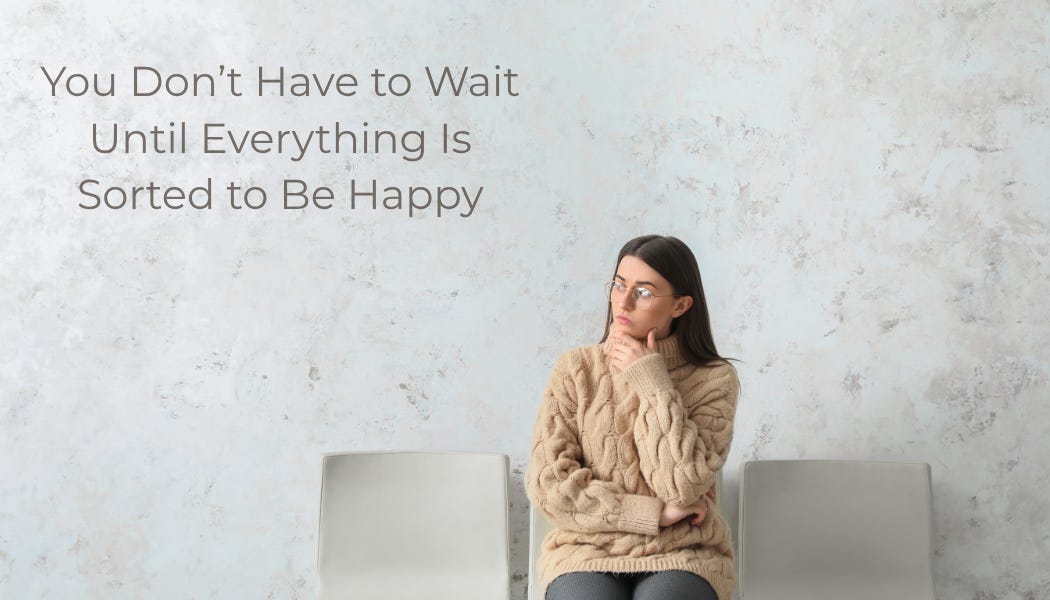
How many times have you said to yourself “I’ll feel better once this is sorted.”
When work calms down.
When I know what’s happening with that appointment.
When the house is finished.
When I’ve lost some weight.
When the money situation feels easier.
When I’ve made the decision.
When I’ve got through this month.
When my body feels more like mine again.
When I know everyone I love is okay.
Then.
Then I’ll relax.
Then I’ll book the holiday, wear the dress, sit in the garden with my book, start the thing, go out for lunch, invite people over, buy the flowers, spend the afternoon doing absolutely nothing.
Then I’ll enjoy myself.
Then I’ll be happy.
Except life has an irritating habit of refusing to be completely sorted.
One thing settles and something else appears. The difficult conversation is finally had, but now there’s something going on at work. The work thing resolves and the boiler starts making a suspicious noise. The boiler gets fixed and somebody you love needs you. You get through that and suddenly your body is doing something peculiar.
And somewhere amongst all of it there are emails and washing and appointments and bills and birthdays and decisions and forms and shopping lists and that cupboard you’ve been meaning to sort out since 2019.
There is almost always something.
Which means that if happiness is only allowed to begin once everything is okay, well we may be waiting for a very long time.
The imaginary point where life begins
I don’t think most of us consciously decide to postpone our happiness.
We don’t wake up one morning and think ‘right. No joy for me until further notice.’
It happens much more quietly than that.
We put something off because this week is particularly busy. We decide not to spend the money because things feel uncertain. We tell ourselves we’ll start looking after ourselves properly when this difficult patch is over. We don’t make plans because we’re waiting for something else to be confirmed.
We stop doing some of the little things that make us feel like ourselves because there are more important things demanding our attention.
All completely understandable, but temporary decisions have a funny way of becoming habits and slowly we begin to organise life around an imaginary future version of ourselves.
She has more time.
More energy.
More money.
Her house is tidier.
Her hormones have settled down.
Her family needs less from her.
Her body behaves itself.
Her inbox is under control.
She knows what she’s doing.
Presumably her washing basket is empty too!
She sounds wonderful but she isn’t here - you are.
This version of you.
With this body, this energy, this bank balance, this family, this workload, this slightly chaotic kitchen drawer, this uncertainty.
This Monday morning.
And this life is happening now.
Not after everything has been sorted.
Happiness and difficulty are allowed in the same room
One of the things I think we sometimes misunderstand about happiness is that we imagine it requires the absence of difficulty.
That to feel happy while something difficult is happening would somehow mean we aren’t taking it seriously enough.
How could I enjoy myself when I’m worried about that?
How can I go out for lunch when somebody I love is struggling?
How can I laugh when there is still so much uncertainty?
How can I feel grateful for my life when part of it feels incredibly hard?
But human beings aren’t built to experience emotions one at a time.
We can miss somebody and laugh until our stomach hurts.
We can be frightened about the future and still notice how beautiful the sky looks.
We can be grieving and enjoy a piece of cake.
We can feel completely fed up with our body and still love the feeling of warm water on our skin.
We can be worried about money and dance around the kitchen to a song we love.
We can be waiting for news and still have a lovely afternoon.
One feeling doesn’t cancel the other.
In Chinese medicine, emotions are understood as part of the movement of life through us. Joy, grief, fear, anger, worry - they all move, overlap, rise and fall.
We get into trouble when we expect ourselves to remain permanently in one emotional state, or when we decide one emotion means we are no longer entitled to another.
Real life is much messier.
Thank goodness - because otherwise we’d have to wait until grief had completely disappeared before we could laugh again.
Until fear had gone before we could feel excited.
Until worry had vanished before we could experience peace.
Until every problem was solved before we could be happy.
And I’m not sure that day exists.
This isn’t about pretending everything is wonderful
I want to be really clear about that.
There are times when life is genuinely difficult.
There are situations that need changing.
There are bodies that hurt.
Relationships that need attention.
Financial pressures that cannot be solved with a white candle and a positive affirmation.
There are diagnoses and losses and endings and periods of exhaustion when simply getting through the day is enough.
Allowing happiness into those places does not mean pretending they aren’t happening or telling yourself you should be grateful because somebody somewhere has it worse. And it certainly doesn’t mean forcing yourself to be cheerful.
Sometimes the happiest thing available to us might be incredibly small.
Ten minutes with the sun on our face.
A really good cup of tea.
The dog doing something ridiculous.
A voice note from somebody who knows exactly how to make us laugh.
Clean sheets.
A song we haven’t heard for years.
Standing outside for a moment and noticing that the air smells different because the season is beginning to change.
These things don’t solve anything.
That isn’t their job.
They simply remind us that the difficult thing is not the only thing happening - there is still life around it.
Sometimes our bodies are waiting too
When we’ve spent a long time dealing with stress or uncertainty, our bodies can become very good at staying ready.
Ready for the phone call.
Ready for the next problem.
Ready to respond.
Ready to help.
Ready to work something out.
Ready for whatever is coming next.
And when that happens, pleasure can start to feel strangely unnecessary, even irresponsible.
There are more important things to do but moments of pleasure, safety and connection aren’t frivolous additions to life.
They are part of how our bodies learn that not every moment requires vigilance.
A nervous system doesn’t only learn safety when all danger, difficulty and uncertainty have disappeared, it can also learn through tiny experiences of safety within an imperfect day.
Those little pieces of evidence that quietly say “this bit is okay.”
And perhaps that is one of the gentlest ways happiness grows.
Not as a grand emotional destination we finally reach, but as moments we become increasingly able to notice and receive.
The rules we quietly make
I wonder whether you have any rules around happiness that you’ve never really noticed?
I can buy myself something nice when I’ve lost weight.
I can rest when the house is tidy.
I can enjoy the weekend once I’ve caught up with work.
I can book that trip when I’ve got more money in savings.
I can start dating when I feel better about myself.
I’ll wear that when I’m more confident.
I’ll have people over when the house looks better.
I’ll start doing things for me when everybody else needs me less.
Some of those decisions might be practical and totally valid, but some might be rules that are worth getting curious about. Because sometimes underneath them is the idea that happiness is something we receive as a reward.
As though there is somebody standing at the gates of joy with a clipboard checking whether we’ve ticked all the necessary boxes to be happy.
There isn’t.
You are allowed to have a lovely day in a body you are still learning to understand.
You are allowed to wear beautiful clothes before you change shape.
You are allowed to rest while things remain undone.
You are allowed to enjoy your money while still being sensible with it.
You are allowed to celebrate something good while something else remains uncertain.
You are allowed to laugh during a difficult season.
You are allowed to experience pleasure without first proving that you deserve it.
The problem with “when things calm down”
I’ve become increasingly suspicious of the phrase when things calm down’ because whilst sometimes things do indeed calm down, often we are waiting for life to create the space rather than creating any space within the life we already have. And life is quite happy to fill whatever space we give it.
There will always be another email.
Another load of washing.
Another job.
Another person who could use our help.
Another thing we could improve.
Another loose end.
So perhaps the question isn’t ‘when will life give me permission to enjoy it?’ but ‘where can I allow enjoyment to exist in the life I already have?’
Not another task.
Not an elaborate self-care routine.
Just noticing.
What already makes you feel good? What have you quietly stopped doing? What have you been saving for some imaginary better time? What makes you feel a tiny bit more alive?
Perhaps happiness is smaller than we think
We tend to use the word happiness for the big things.
The holiday.
The wedding.
The new job.
The achievement.
The big night out.
The moment something we desperately wanted finally happens.
Of course those moments are wonderful but they are occasional, and a life built only around big happiness would contain an awful lot of waiting in between.
Perhaps everyday happiness is quieter.
Just noticing gentle moments of ‘nice’.
And perhaps we underestimate how much a life made up of enough nice can become a very good life indeed.
Your Monday morning invitation
So I have two questions for you this week.
The first is ‘what am I waiting to sort out before I let myself enjoy my life?’
Don’t force an answer, just notice what comes.
And then ask yourself “what could I let myself enjoy anyway?”
Because this is your life too
There will be periods when happiness feels easy and others when we have to look much more carefully for it.
There will be things we wish were different.
Things we are actively changing.
Things we cannot change yet.
Things we may never be able to change.
But happiness does not require us to finish all of that work first.
It can sit alongside the unfinished bits.
Alongside the uncertainty.
Alongside the healing.
Alongside the mess.
Alongside the things we’re still figuring out.
Perhaps that is one of the kindest things we can learn as we get older - we don’t have to wait for the perfect version of our lives before we start inhabiting them.
We don’t have to save all the lovely things for later.
We don’t have to postpone joy until everybody else is okay.
And we don’t need every piece of the puzzle to be in place before we’re allowed to look around and think ‘actually, there is something good here.’
Because absolutely will be.
Something warm.
Something funny.
Something beautiful.
Something peaceful.
Something delicious.
Something that makes you feel a little more like yourself.
Something worth noticing.
The unfinished things will still be there afterwards, but for a moment, they don’t have to have the whole room.
So this week, perhaps don’t ask yourself how to become happier.
Just notice where happiness is already trying to find you, and when it does -you don’t have to make it wait.