January has a reputation for being the month of fresh starts. Clean slates. New routines. Better habits. A version of you who somehow wakes up on the 1st brimming with energy, discipline and drive.
But for so many women, January doesn’t feel like that at all.
It feels heavy.
Tender.
Disjointed.
Exhausting before it’s even begun.
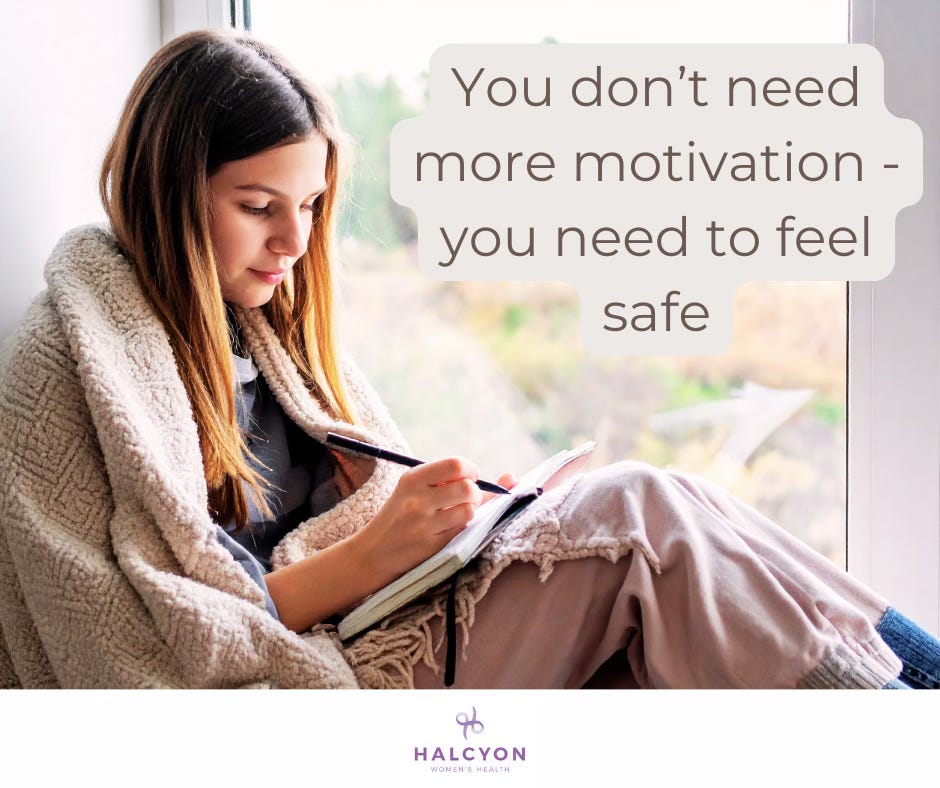
And the problem isn’t that you’re unmotivated.
The problem is that your body doesn’t feel safe.
We’ve been taught to believe that motivation is the missing ingredient — that if we could just want it enough, we’d change. That if we were stronger, more disciplined, more focused, we’d finally stick to the routine, the plan, the promise we made to ourselves.
But biology tells a different story.
Your nervous system doesn’t respond to pressure.
It responds to safety.
And without safety, motivation simply doesn’t land.
What does “feeling safe” actually mean?
When we talk about safety, we’re not just talking about physical danger. We’re talking about nervous system safety — the felt sense that you are not under threat, that you don’t need to brace, perform, mask or push to survive.
Safety feels like:
Being able to exhale fully
Muscles softening without conscious effort
Thoughts slowing rather than racing
A sense that you can pause without consequence
It’s subtle. Quiet. Often unfamiliar.
For many women — especially those who are midlife, juggling work, care, health, hormones, finances and emotional labour — safety hasn’t been a consistent experience for a very long time.
You may be highly capable. Functioning. Getting things done.
And still not feel safe.
Because safety isn’t about competence.
It’s about capacity.
Why you might not feel safe (even if life looks “fine”)
So many of the women I work with say some version of this:
“I don’t know why I feel like this — nothing terrible is happening.”
But your body doesn’t measure safety by logic.
It measures it by load.
Hormonal fluctuations, chronic stress, pain, inflammation, poor sleep, emotional labour, unresolved grief, financial pressure, caring roles, years of being the one who copes — all of these tell the nervous system to stay alert.
Add to that:
A lifetime of being praised for pushing through
Cultural messaging that rest must be earned
Workplaces that reward output, not wellbeing
Health narratives that focus on fixing rather than listening
And your body learns that slowing down isn’t safe.
So when January arrives and the world starts shouting “do more, change more, be better”, your system doesn’t get inspired.
It contracts.
Why January can feel especially hard if you don’t feel safe
Winter is already a time when energy naturally pulls inward. Less light, colder days, disrupted routines, heightened inflammation, lower mood for many women.
Your hormones are also responding to this seasonal shift — cortisol patterns change, melatonin increases, serotonin can dip. Your body is biologically primed for conservation, not acceleration.
So when January arrives with its lists and demands, your nervous system is caught between two opposing forces:
The body asking for gentleness and restoration
The world demanding productivity and progress
And if safety isn’t present, that tension shows up as:
Procrastination
Overwhelm
Fatigue
Emotional flatness
Self-criticism
“What’s wrong with me?” thinking
This isn’t failure. It’s not you being rubbish or ‘less’.
It’s self-protection.
Why change can’t embed without safety
You can force change without safety — but you can’t sustain it.
When your nervous system is in a state of threat (even low-level, chronic threat), it prioritises survival over growth. That means that habits don’t stick, routines feel brittle, willpower gets exhausted and, without fail, the body eventually rebels
True, lasting change — the kind that reshapes your health, your relationship with your body, your work patterns, your boundaries — only happens when your system feels resourced enough to allow it.
Safety is what allows:
New neural pathways to form
Hormones to rebalance
Inflammation to settle
Behaviour to shift without punishment
This is why so many women say “I know what I should do — I just can’t seem to do it.”
It’s not a knowledge gap.
It’s a safety gap.
How safety feels (when you start to find it)
Feeling safe doesn’t feel like excitement or motivation at first.
It often feels like:
Relief
Softness
Slowness
A slight sadness as your body realises it doesn’t have to brace anymore
Sometimes safety arrives as tears.
Sometimes as tiredness.
Sometimes as a sudden need to rest.
That’s not regression.
That’s your system recalibrating.
And from that place — gently, organically — energy begins to return.
Not the frantic, brittle energy of forcing.
But the grounded, sustainable energy of choice.
Three ways to create safety — now and over time
1. Create safety in the moment: orient and anchor
When you feel overwhelmed, stuck or numb, don’t ask yourself to do more.
Ask your body to arrive.
Plant your feet on the floor.
Name five things you can see.
Feel the support under your body.
Lengthen your exhale — just a little.
This tells your nervous system: I am here. I am supported. I don’t need to rush.
Do this before decisions. Before plans. Before self-judgement.
Safety first. Always.
2. Create safety in your language
Notice how you speak to yourself in January.
Is it harsh?
Demanding?
Impatient?
Your nervous system is listening.
Try swapping:
“I need to get my act together”
for
“What would help me feel more supported today?”
This isn’t softness for softness’ sake.
It’s effective communication with your biology.
3. Create longer-term safety through rhythm, not routines
Rigid routines can feel threatening to a nervous system that’s already stretched.
Instead, experiment with rhythms:
When do you naturally have more energy?
When does your body ask for rest?
What helps you feel regulated rather than depleted?
Work with your hormonal and energetic reality, not against it.
This is how safety becomes a lived experience — not a concept.
A gentler reframe for this week
If January feels hard, please know that you’re not the only one feeling this and it doesn’t mean that you’re failing.
If motivation feels absent, you’re not lazy.
If change feels out of reach, your body may simply be asking for safety first.
You don’t need to push.
You need to listen.
And that, in itself, is a powerful beginning.
Next Steps
If this resonates, my work supports women and organisations to understand and work with hormonal reality — not against it.
More here
No fixing.
No forcing.
Just safer ways forward.